












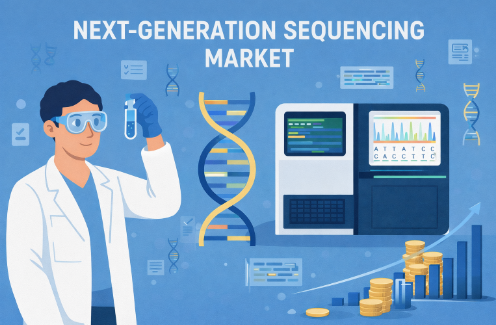
The world of Next-Generation Sequencing (NGS), the revolutionary technology that deciphers genetic code with staggering speed and plummeting cost, is no longer just a scientific arena. It has erupted into a high-stakes battlefield of corporate strategy, where multi-billion dollar mergers, aggressive investments, and drug development pipelines are colliding. The drivers: the relentless pursuit of the $100 genome, the integration of genomics into routine healthcare, and the promise of ultra-personalized medicine. The result is a market undergoing a seismic transformation, with its top players maneuvering for dominance in a space projected to explode in value.
The numbers underscore the frenzy. According to SNS Insider, The Next-Generation Sequencing Market size was worth USD 8.3 billion in 2023 and is estimated to reach a valuation of USD 50.0 billion by 2032, propelling at a CAGR of 22.0% over the forecast period of 2024-2032. This astronomical growth is not happening in a vacuum. It is being directly catalyzed by a wave of strategic mergers and acquisitions (M&A), massive capital inflows, and a tangible pipeline of drugs developed using NGS insights, creating a self-reinforcing cycle of innovation and commercial expansion.
The M&A Frenzy: Consolidating the Ecosystem
The past 18 months have witnessed a landmark consolidation, fundamentally altering the competitive map. The blockbuster acquisition of Grail by Illumina, finalized in 2021 amidst global regulatory scrutiny, set the tone. Though now undergoing a mandated divestiture, the $8 billion deal highlighted a central theme: the push to move NGS from the research lab directly into cancer screening and early detection in mainstream clinics. Illumina’s strategy, albeit currently contested, was to vertically integrate Grail’s groundbreaking multi-cancer early detection blood test with its own sequencing dominance.
Simultaneously, Thermo Fisher Scientific has been executing a strategic acquisition spree to build an end-to-end powerhouse. Its purchases of Qiagen’s advanced sequencing asset, Mesa Biotech, and Core Informatics were not merely additive; they were designed to create an indomitable workflow from sample prep and sequencing to complex data analysis. This horizontal and vertical integration allows Thermo Fisher to offer bundled solutions, locking in customers across academia, pharma, and clinical labs.
Meanwhile, newer players are leveraging M&A to scale at breakneck speed. Pacific Biosciences (PacBio) acquired Omniome in 2021, gaining access to its high-accuracy, short-read sequencing technology. This move was a direct challenge to Illumina’s core short-read stronghold, allowing PacBio to offer a more comprehensive portfolio. Similarly, Oxford Nanopore Technologies has used targeted acquisitions to bolster its bioinformatics and sample preparation capabilities, essential for its unique long-read, portable sequencing devices.
Investment: Fueling the Fire
Parallel to M&A, venture capital and public market investment are pouring into the sector. Startups focusing on niche applications—single-cell sequencing, spatial transcriptomics, and AI-driven genomic interpretation—are raising record rounds. Companies like 10x Genomics, Singular Genomics, and Ultima Genomics have collectively raised over $1.5 billion in recent years, with Ultima famously entering the fray with a promise to ultimately deliver the $100 genome. This influx of capital is accelerating innovation, pushing incumbents to advance their platforms faster and driving down costs, which in turn expands the addressable market.
From Sequence to Therapy: The Drug Development Engine
The most potent validation of NGS’s value, however, comes from the pharmaceutical industry. NGS is no longer just a research tool; it is the cornerstone of modern drug discovery and development. The rise of precision oncology is the prime example. Drugs like Amgen’s Lumakras (sotorasib), developed to target tumors with specific KRAS G12C mutations identified via NGS, illustrate the direct pathway from genomic sequencing to approved therapy. Companion diagnostics, which use NGS panels to identify patients eligible for targeted therapies, are now standard in oncology clinical trials.
Furthermore, the field of minimal residual disease (MRD) monitoring in cancer, led by companies like Natera and Guardant Health, relies entirely on ultra-sensitive NGS to detect trace cancer DNA after treatment, guiding decisions on therapy continuation. This application alone is creating a multi-billion dollar recurring revenue stream within the NGS market.
Beyond oncology, NGS is accelerating drug development in rare genetic diseases, infectious disease surveillance (as starkly demonstrated during the COVID-19 pandemic), and pharmacogenomics. The ability to sequence pathogens in real-time or understand genetic factors in drug response is shrinking development timelines and improving success rates, making NGS an indispensable asset for Big Pharma. Major players like Roche, Pfizer, and AstraZeneca are increasingly embedding NGS into their R&D engines and forming deep partnerships with sequencing companies.
The Top Players and the Road Ahead
The current landscape is dominated by a handful of giants with distinct strategies. Illumina remains the undisputed market leader in short-read sequencing but faces regulatory headwinds and mounting competition. Thermo Fisher leverages its vast distribution and product breadth. Pacific Biosciences and Oxford Nanopore are carving out leadership in long-read sequencing for complex genomic analysis and field applications, respectively.
The road to 2032 will be defined by several key battles: the race for clinical ubiquity through FDA-approved, reimbursement-backed tests; the data interpretation war, where AI will be the differentiator; and the technological showdown to achieve the $100 genome with clinical-grade accuracy. As the market balloons toward the $50 billion mark, further consolidation is inevitable. Expect mid-sized diagnostic companies with strong clinical pipelines to become attractive targets, and watch for potential moves by big tech companies, drawn by the massive data generation of genomics.
In conclusion, the Next-Generation Sequencing market is experiencing a perfect storm of financial, strategic, and scientific forces. The staggering growth forecast is not a mere projection but a reflection of current dynamics: aggressive M&A building integrated behemoths, relentless investment fueling disruptive newcomers, and tangible drug successes proving NGS’s transformative power. The sequencing of life is now inextricably linked to the sequencing of capital and corporate strategy, setting the stage for a decade of unprecedented advancement in how we understand and treat disease.